Number plate 1111
The Dream of the Mermaids (2005)
The second year I wrote to the Three Kings, I wanted to ask for something I truly believed was impossible. I wrote, “To appear on television and be introduced as one of the best photographers in the world.”
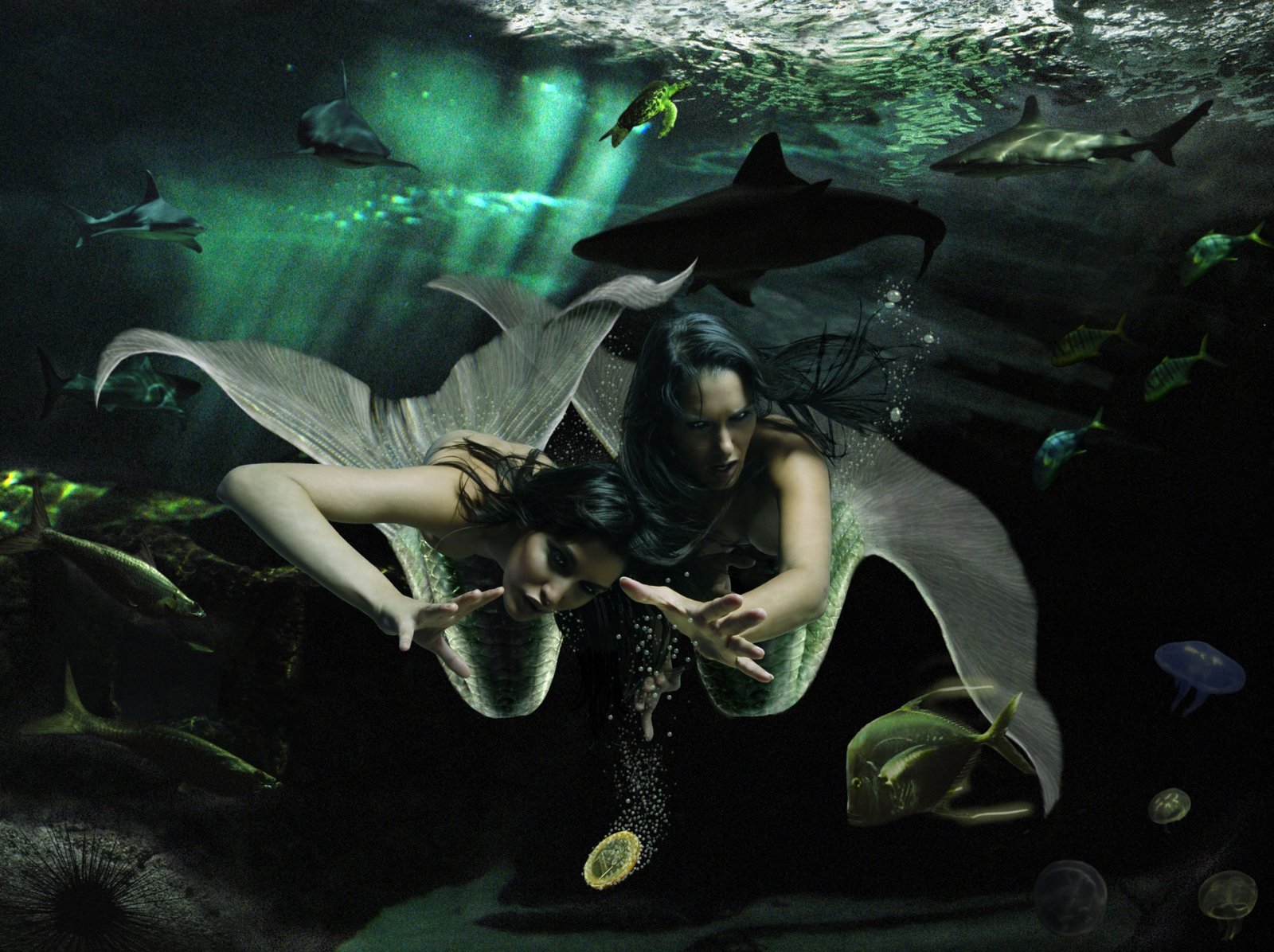
I had worked as a studio assistant at Daylight alongside some of the finest photographers of the time. People there often said that the best of them tended to work with a single light. I found that extraordinarily difficult. Some time later, inspired by a book by the Master Saint-Germain, I stood up and declared, “I am the master of light.” That night I dreamt of two mermaids fighting over a coin underwater. When I woke, I drew the scene.
What I wanted to photograph was the light that seemed to rise from around their bodies. In the studio, with one light, some sheets of decorator’s plastic and a fan, I made the air look like water. Years of directing actors helped me draw the gesture I wanted from the models. Something I had struggled to understand at Daylight was suddenly clear to me. I began to light my photographs that way. For me it was a quantum leap. The Dream of the Mermaids was the first photograph in which I could see how far my work had come.
A series of encounters followed that I came to recognise as synchronicities. One of them was with Agnes, a make-up artist and stylist. Together we made a portfolio that gave me room to keep working with light in this way. We posted it on the website of Spain’s association of professional photographers. Albert, a creative at Grey, came across it while looking for a photographer for an international campaign. When we met, he told me which photograph had prompted him to call. It was the mermaids.
While I was working on the campaign, another commission came in. I was asked to take photographs for a brochure for the Ibero-American Summit in Salamanca. I photographed a girl blowing a soap bubble that represented the Earth. Soon afterwards I saw the photograph on billboards, and then, on a scale I had never imagined, behind the presidents as they gave their speeches.
Original photograph for the Salamanca Summit, 2005. Carlos Bernal Iglesias.
Ricardo Lagos, then President of Chile, speaking in front of the photograph.
Around that time, a crew from El Refresco , a programme on Onda 6, came to my studio. They were looking for a photographer who shot portfolios for actors. That was how I made my living, and that was what they had come to film. Once inside, they also saw the mermaids, the advertising campaign and the Salamanca photographs. Perhaps seeing all that work together changed the impression they had formed of me.
The surprise was mine when the programme aired. I sat down in front of the television and heard the presenter call me “one of the best photographers in the world”. I knew the words the moment he said them. They were the ones I had written in my second letter to the Three Kings.
I have no recording of that broadcast. In those days I never kept anything I did.
Even now, I trace everything that followed back to that impossible wish. When I wrote the letter, how could I have imagined that somewhere between that sheet of paper and a man’s voice on television I would dream of two mermaids?
Blue Tantra (2005)
After the Onda 6 broadcast I asked the divine for inspiration again. I was still working on post-production for the advertising campaign. I admired the retoucher’s work, but whenever I heard people debating how much of each photograph was his and how much was mine, I felt my signature fading. I wanted to return to art and make a photograph I could call finished the moment the shutter closed.
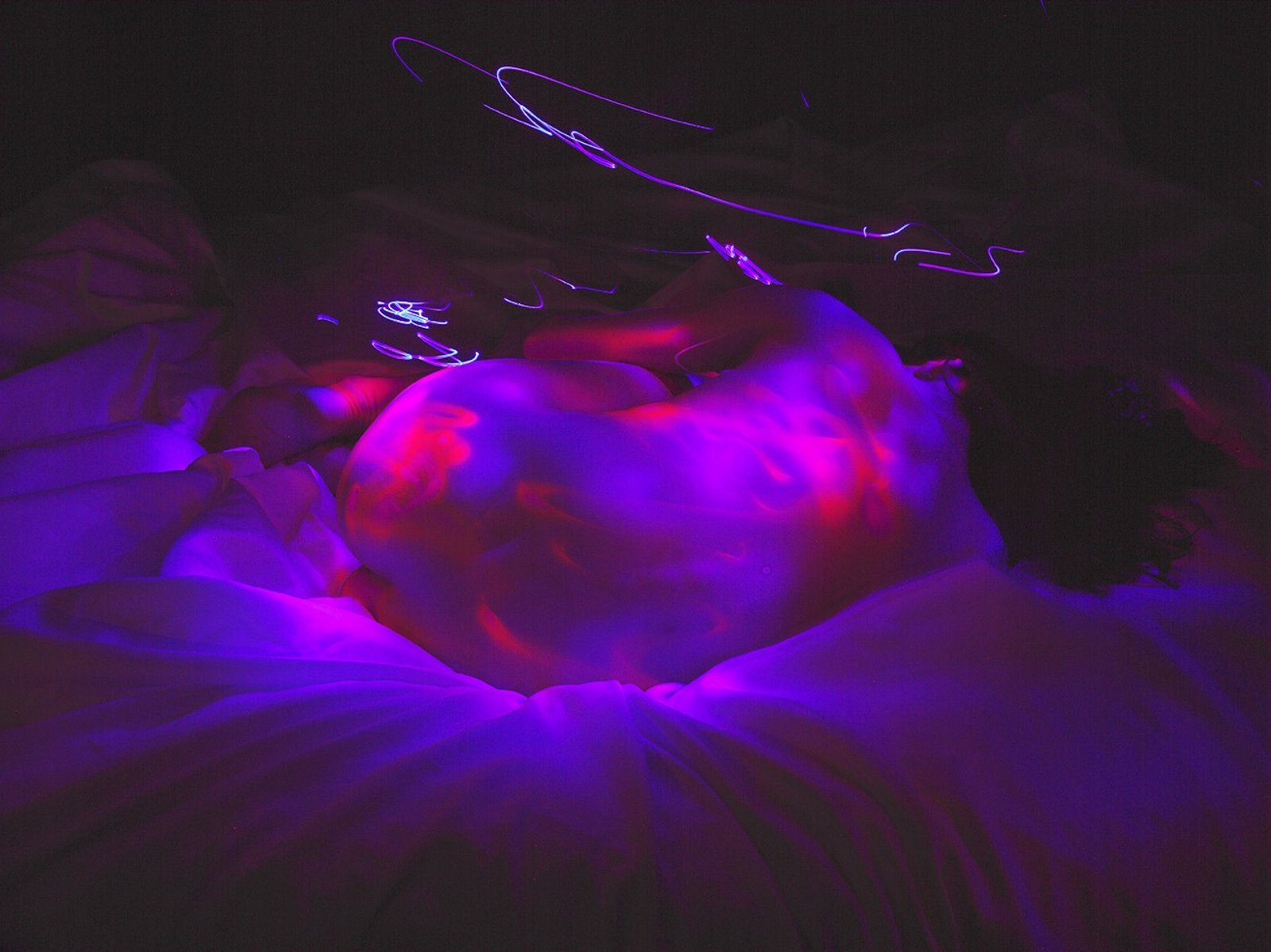
An Argentine journalist gave me a plastic lighter with a little blue torch built into it. That night I lit a pink candle and asked Ángeles to pose for me. I left the shutter of my Hasselblad open for thirty seconds. With the lighter in my hand I painted around her body. In the photograph I recognised the movement of my hand in the blue line beside her skin. There was something sacred to me in that image of the woman I loved. I left it just as it had come out of the camera.
I went on to photograph other women. I asked them to come at ten at night. I would spread the white lining of a wedding dress over the bed and put on some music by Enya. With the camera on a tripod I could move around the woman as she posed. My arms followed the music. Sometimes the light caught a fold in the fabric and in the photograph it looked like a lunar landscape.
Around then the director of Grey called me into his office in the Torre Picasso. He was delighted with the campaign and wanted to introduce me to other agencies. I stood looking out at Madrid through the glass. Only a short time before, it would have seemed to me the most a photographer could hope for. “I’m leaving advertising for art,” I told him. I remember how light I felt as I walked out of that tower.
With the third woman I photographed, a shadow appeared on the screen that seemed to rise from her belly. We kept shooting and the images continued to unsettle me. Until then I had been trying to recapture the beauty of that first night with Ángeles. From then on I let go of the picture I had in mind. I felt that something greater than myself was guiding the series, and I wanted to see where it would lead.
I set myself the task of making fifty photographs. After a year I stepped in front of the camera myself. The self-portrait that closes Blue Tantra is about my own death. One night, as I looked through the series, I turned down the brightness of the screen. The bodies slipped from view. What remained were strokes of light that reminded me of Japanese calligraphy.
To give the photographs their titles, I sat with each one and wrote down the words that came to me. Some of them frightened me. I went back and changed the ones that felt too dark. When at last I read all fifty titles in succession, I discovered I had written a love letter.
The Co-creation of Nora As I photographed Nora stretching out on the armchair, I began to see hearts in her markings. Those shapes reminded me of something I had drawn during the experiment, before I knew her.
About nine months before I found Nora, I told J. J. that I wanted a dog. He asked me what I wanted her to look like and passed me a sheet of paper and a pencil. I drew her in black and white, with a dark mask across her face. I put an arrow on one flank and two ovals on the other. As I drew them I thought that if I ever photographed her, those patches might look like hearts.
I wanted her to be gentle and brave. I also asked for a dog that would drink straight from the tap. When I went walking in the hills with my other dogs, I used to cup my hands to give them water, and my fingers would go numb with cold. J. J. asked me to add something dogs didn’t do. I thought she might moo like a cow and, once in a while, wink at me.
Early in 2007 I went to the animal shelter. It was a Monday. A black-and-white puppy ran up to the gate and began licking my fingers. The woman showing me round said there were more puppies to see. I wanted to stay there with her a little longer. I went back for her on Saturday. At the shelter they called her Berlín. Ángeles suggested we call her Nora.
At the shelter the drawing never even crossed my mind. It came back to me at home, with the camera in my hands. In this photograph Nora is lying on her back on the checked armchair. The outline of the patches changed as she stretched her legs. There were the hearts I had imagined on paper.
When Nora stretched she made a sound like a cow lowing. Sometimes she winked at me. I even managed to photograph one of those winks. When she was thirsty she would go into the bathroom and wait beside the bidet for me to turn on the tap. To recognise in her even those things I had asked for almost in jest made me feel that the spiritual world had heard me. That is what I mean when I speak of co-creating Nora.
The Co-creation of Nora · 7:07 What London Reflected Back to Me There is a girl in the window of the red bus. The frame hides part of her face, but I can see her hand on the rail among the blue seats. At the top of the picture an advertisement is cut off. Looking at the photograph today, I linger over the words “your own world”. I wonder how much of what I saw in London had travelled there with me.
I went in early December 2006 with my friend Juan and his son Alejandro. They were sightseeing. With the help of my friend Joanna Wivell, I hoped to show Blue Tantra to a few galleries. Juan had chosen our hotel without knowing what I had in mind. When we arrived I saw the name over the door, Exhibition Court Hotel . I wanted so much to exhibit my work that coming across that word in that particular place felt like a synchronicity. I photographed the entrance.
Out on the streets I took photographs by instinct. London held me in its spell, yet the coldness I thought I saw in people troubled me. Looking again at the faces I had photographed, I felt the city looking back at me. I had gone there to ask others to stop and look at my work. How had I been looking at them? It was hard to recognise my own indifference in those photographs. My fears were there too, and my arrogance.
Making the photobook helped me put some of what I was feeling into words. In one photograph a man stands in a red telephone box, receiver in hand, looking over his shoulder. Beside that picture I wrote, “The unwillingness to let go of the past when our heart is divided.” I was writing about myself.
In the years since, I have often thought about the help I was given on that trip and how little I knew how to thank people at the time. There are things I would do differently if I could go back. In the book I wanted to thank those who had been there with me. I called them “the souls who, with humility and patience, held up a mirror to me”.
London Soul photobook · 4:35 What I Saw When I Got Home I had been listening to a Tibetan mantra as I walked through the streets. I was still listening when I entered the Reina Sofía. In the galleries I began photographing the people who stopped in front of the works. I took the pictures by instinct. At the time I would have been hard pressed to say why one person had caught my eye and the person beside them had not.
It was at home, looking through the photographs, that I began to see what had happened in the gallery. In one picture a woman in glasses holds a leaflet at her waist. My eye follows the pattern of her dress to the yellow and red figures in front of her. When I look back at the woman, for a moment she seems to be part of the work herself.
Looking again at the pictures I had taken at the Richard Hamilton exhibition, I had the feeling of being inside a dream. The visitors’ gestures, and even those of the museum staff, seemed to answer something on the walls. If you were to ask me what it all meant, I would still find it hard to say. What stays with me is that it was there in front of me, and I needed the photograph to see it.
I call that way of looking “second attention”. When I open the photobook I can return to that gallery, turn a page and pause again with someone who had stopped to look.
Quantum Museums I photobook · 4:05A Question in Puerta del Sol In May 2011 I took my camera to Puerta del Sol, the square in Madrid where the 15M protesters had set up camp. Of all the people who were there, the one who stays with me in this photograph is a man beneath a tarpaulin. The fabric brushes his forehead. His mouth is open, his head tipped back, one hand in the air. When I look at him, I wish I could hear his voice.
Seeing the square full of people brought to mind something I had apparently said years earlier, during an experiment with my subconscious. I knew those words only from what others had told me. I still remember standing in that crowd and thinking of words that belonged to such a private moment in my life. Even now I find it hard to describe what I felt when I recognised the coincidence.
In one of the colour photographs in the book, you can read the words people left in the square. Above the tarpaulins hangs a banner that reads ‘¡No nos representan!’ — ‘They don’t represent us!’ Below it, handwritten notes cover a post. Whenever I open the book, I can stop and read them. I also come back to the question I took away from Sol. How far can the mind reach?
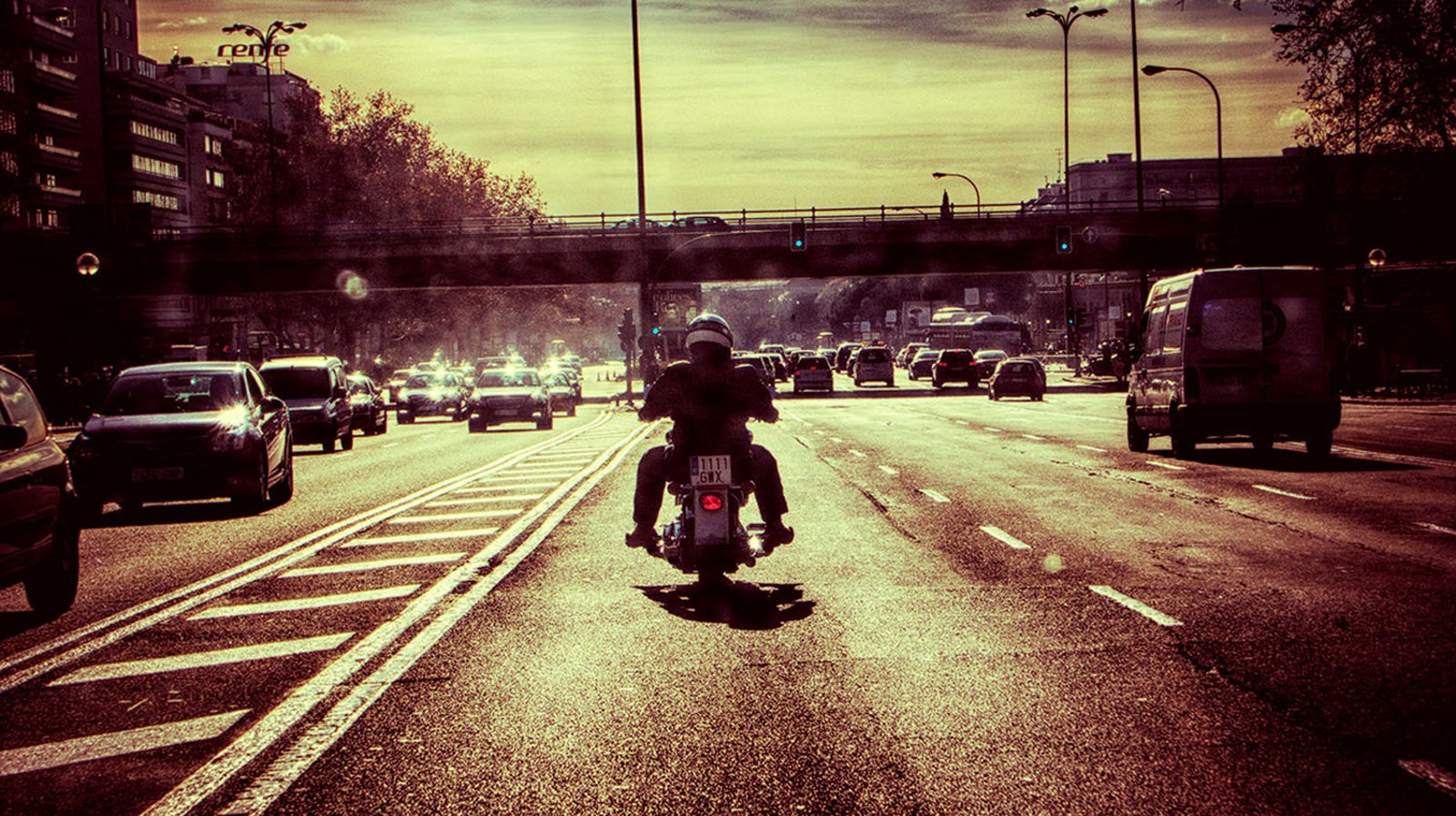
15M photobook · 3:08What Appeared in My Lane There’s a motorbike ahead of me in the middle of the avenue. Sunlight glints off the road. You have to look closely at the photograph to make out the four ones on the number plate. Of all the vehicles heading towards the bridge, it was those digits that drew my eye to the bike.
After the experiment in which my subconscious was programmed, I began experiencing one synchronicity after another on the road. I’d point out a car that had just pulled in front of us and show Ángeles the plate. Three identical digits again. One day she said she’d find it harder to explain a number that read the same backwards, or four identical digits. When I started seeing those too, I wanted to photograph them. If I ever doubted my memory, at least I could look again at what we’d seen.
I’d been photographing those number plates for more than a year when I stopped. Several months went by, and the synchronicities disappeared too. Around that time, everything I tried seemed to fall apart in ways that felt surreal. One night I found myself at a loss as to where to go from there. In desperation, I prayed with all my heart and asked God to give me a sign.
The very next day the patterns returned, more striking than before. The first sign came in a tunnel on Madrid’s M-30. Three cars drew level with one another ahead of me, one in each lane. I recognised a pattern on every plate. I’d asked to be shown a way forward, and when I saw those cars I felt I had my answer. I needed to go back to making art.
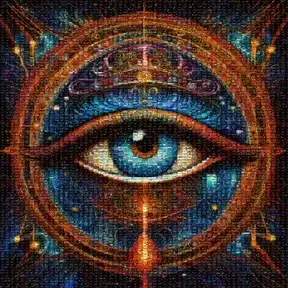
When I picked up the camera again, I kept to the rule I’d set myself at the outset. I would only keep a photograph if the vehicle had appeared directly ahead of me, in my own lane. I came to call that commitment ‘a pact with the divine’. Over the years I gathered thousands of photographs of those synchronicities. From them I made the eyes in The Quantum Gaze . There’s a magnifying glass on the cover of the photobook. Turning its pages, I can still look at the photographs one by one, taking in the whole street before looking more closely at the few digits that drew my eye.
What still surprises me is the timing. At moments that mean a great deal to me, a car pulls in front of me in my own lane, and there are those numbers again. Sometimes the coincidence is so strange that I feel as though I’m being asked to pay attention. I take it as a sign to carry on with my work. With my camera I try to show that world the eye cannot see. In those encounters I sense something vaster than the eye can take in, something divine that holds everything together.
December 2026
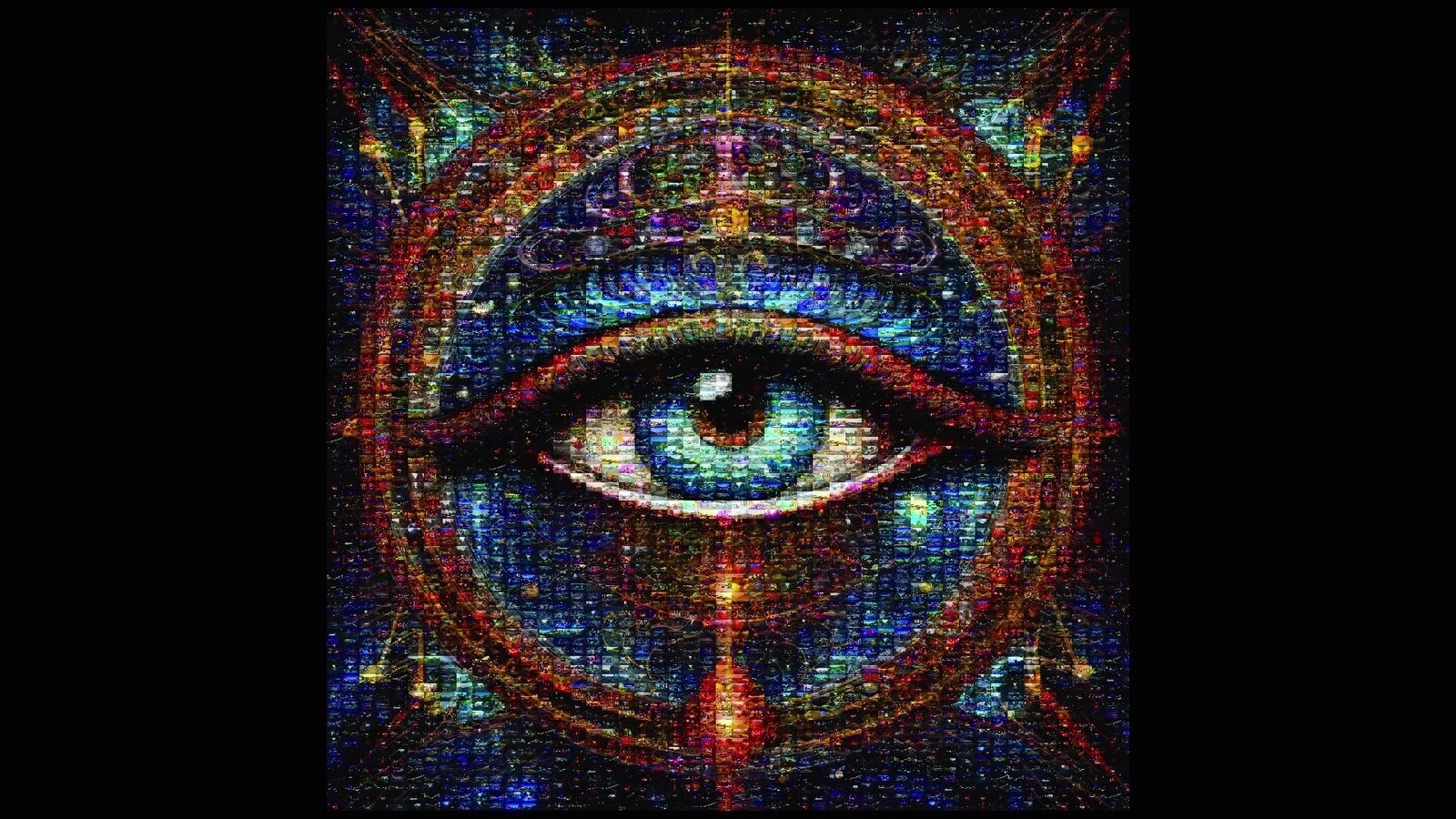
Intangible Signs photobook · 5:09 The Quantum Gaze What moves me in each synchronicity is the moment I recognise the numbers. Something I’ve been experiencing inwardly is suddenly there in front of me, on a car’s number plate. For an instant I feel that the observer and the observed are one. I experience that moment as sacred, as though creation were looking at itself through my eyes.
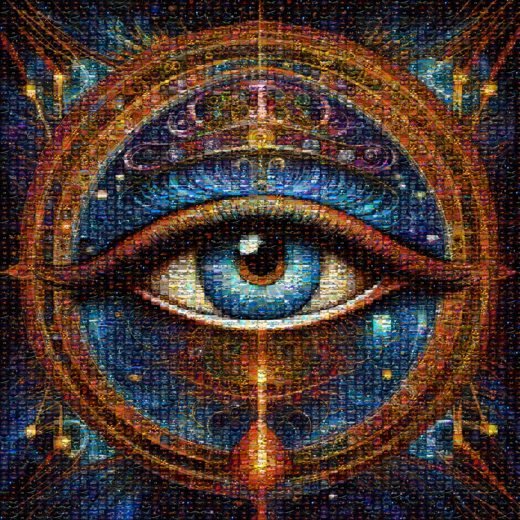
That was the idea behind The Quantum Gaze as a work of conceptual art. I brought the photographs together in mosaics so that the very things I’d looked at on the road could form an eye that now looks back at you. I wanted its gaze to express the unconditional love I feel in those encounters. Up close, you can make out a reflection on a car’s bodywork or the glow of a brake light. From a few steps away, the colours of thousands of photographs trace the iris and the eyelid.
The works measure 200 × 200 cm and can be reproduced at up to 400 × 400 cm. Stand close to a print of Eternal Light at that scale and you can read the four zeroes on the white car’s number plate. Step back a few paces and the eye meets yours again. That change of distance is the closest I’ve come to sharing with you what happens to me on the road.
On screen, you can make that same journey from the eye in Eternal Light to the white car’s number plate.
Zoom in
At the Foot of the Hill
As a boy, I knew my grandfather’s greyhounds through a story my mother used to tell me. She would hold them at the foot of a hill on the outskirts of Madrid while her father climbed. The dogs strained at their leads, trembling to be off. When he called from the top, she let them go. The day I drew Nora during the experiment, I also asked for two greyhounds that looked alike. I wanted the female to be orange. For me, the pair that would one day share our home came into being there and then.
A year after we lost Nora, Ángeles and I went back to the shelter where we had adopted her. We went looking for a female and came home with Cinco, a five-year-old brindle male. Whenever the other dogs started to play, he took shelter between my legs. Then one day, at a park by Madrid’s Casa de Campo, a russet-coloured greyhound came in. Her name was Eevee. Cinco ran off to play with her. I’d never seen him play like that.
A month later, Eevee’s owner rang to say he could no longer keep her. We agreed to take her for the weekend and see how it went. That first night, as the dogs sought each other out and settled down together, I looked at Ángeles. She nodded. Eevee stayed. There in front of me was the pair I had asked for all those years ago.
I began photographing them on our sofa in natural light, just as they lay. In Greyhounds II , I made the background black so the eye would come to rest where one dog lays its head and the other bears its weight. I wanted to keep something of that trust. And seeing them so still in the photograph, I could see my mother’s greyhounds again, racing up the hill.
 Artwork description